What Do YouTube Viewers Want? Decode Audience Intent in 2026


In 2025, YouTube's average engagement rate dropped to 2.34% — down from 3.73% the year before, a 37% decline (Metricool, 2026). Comments grew 38% year-over-year over the same window. Pull those two together: viewers are talking more, and the average creator is hearing less of what they're saying. Views aren't the problem. Listening is.
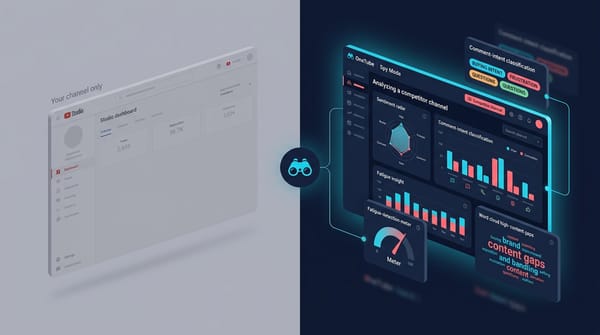
The audience tab in YouTube Studio shows who watched. It doesn't show why they came back, what they wanted you to make next, or which video idea your competitor's audience has been begging for. That signal sits inside comments — yours, and on the channels in your niche. The hard part isn't reading them. It's reading them at scale.
Key TakeawaysYouTube engagement dropped 37% in 2025 while comments grew 38% (Metricool, 2026) — viewer feedback volume is rising as channel-level metrics fall.Average YouTube video retention is 23.7%, and 55%+ of viewers drop in the first 60 seconds (Retention Rabbit 2025 Benchmark Report).91% of creators now integrate AI into their workflow; 46% use it for creative inspiration (Epidemic Sound Future of the Creator Economy Report 2025).The only scalable way to decode "what viewers want" is to classify every comment by intent and emotion — then read the patterns, not the lines.
Why viewer intent matters more than viewer count
Raw subscriber and view counts can stay flat while the signal underneath shifts dramatically. Average YouTube retention is 23.7% across long-form video, and 55%+ of viewers drop inside the first 60 seconds (Retention Rabbit 2025 Benchmark) — meaning more than half of your audience never reaches the content you actually wrote the script for. Brutal numbers.
YouTube Studio's 2025 audience tab refresh added useful segmentation: new / casual / regular viewers, age, gender, geography, device split. All of it answers who showed up. None of it answers what they thought, what they asked for, what made them stop watching. To get that, you have to read the discussion under your own videos — and the discussion under videos in your niche that you didn't make.
The asymmetry creators talk about most on r/PartneredYoutube isn't follower growth. It's the feeling of working in the dark — guessing at scripts, posting consistently, then watching views collapse without a clear "why." One 2025 academic survey of r/NewTubers identified that the dominant creator pain narrative is broken feedback loops — algorithms feel opaque, comments feel scattered, and the only response is to post more and hope (Gallagher & Hernandez, SAGE 2025). Posting more without listening better is how you stay stuck.
What do YouTube viewers actually want? Look at intent, not topics
Most "what your audience wants" advice tells you to read your comments. Nobody tells you how to read 4,000 of them in a useful order. The unlock isn't the volume — it's the taxonomy. When you classify every comment by intent and emotion, the chaos becomes a small, repeating set of patterns.
Across the channels in our trial workspace, a small set of intent categories accounts for roughly 90% of substantive comments: questions, praise, criticism, suggestions, and discussion. Stack emotion classification on top — from grateful to skeptical — and a video that "got 800 comments" turns into something you can actually read: "320 questions, mostly curious; 180 praise, mostly grateful; 90 criticism, half disappointed and half skeptical; 60 suggestions; the rest is discussion." That's a decision-grade summary. Free-scrolling won't give you that.
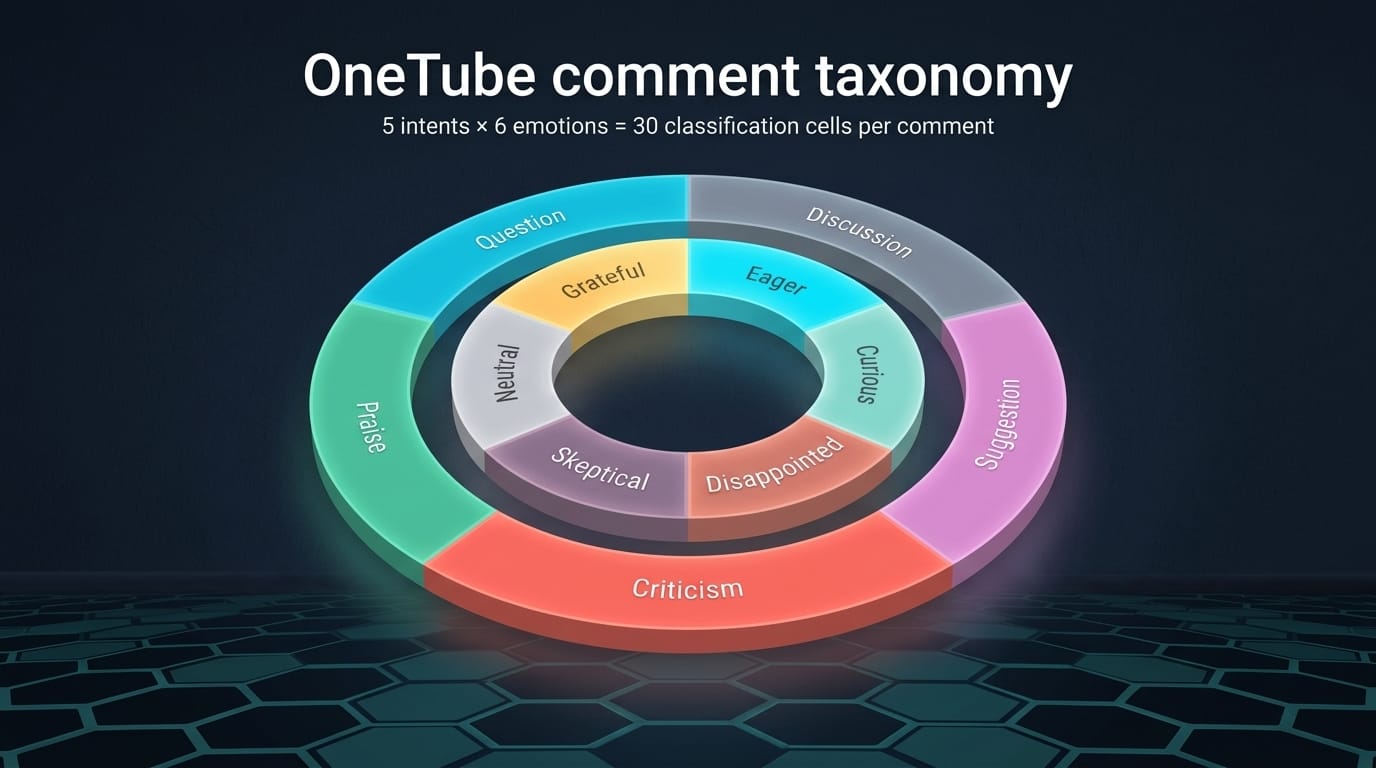
The bucket that matters most for "what do my viewers want": suggestions, plus the questions that come up repeatedly across multiple videos. Those two together are the closest thing you have to a content-direction signal. Praise tells you what's working. Criticism tells you what's breaking. But questions and suggestions are the most direct version of "here's what we want you to make next."
How do you read 4,000 comments without losing your week?
You don't, manually. In 2024, the average long-form YouTube video collected 4 comments; Shorts averaged less than 1 (Statista, 2024). That sounds light. It isn't, once you scale: a creator analyzing their own 50-video back catalog plus 5 competitor channels with 30 videos each is staring at ~800 comments to read, classify, and remember — every quarter. Doesn't scale.
The fix is to make the classification automatic and the surfacing intelligent. Each comment gets tagged by intent and emotion as it's ingested. Repeating themes — actually, more accurately, recurring phrases inside the same intent bucket — bubble up as a "top audience questions" list or "top content ideas" surface for the channel. The point isn't to read every comment. It's to read the patterns.
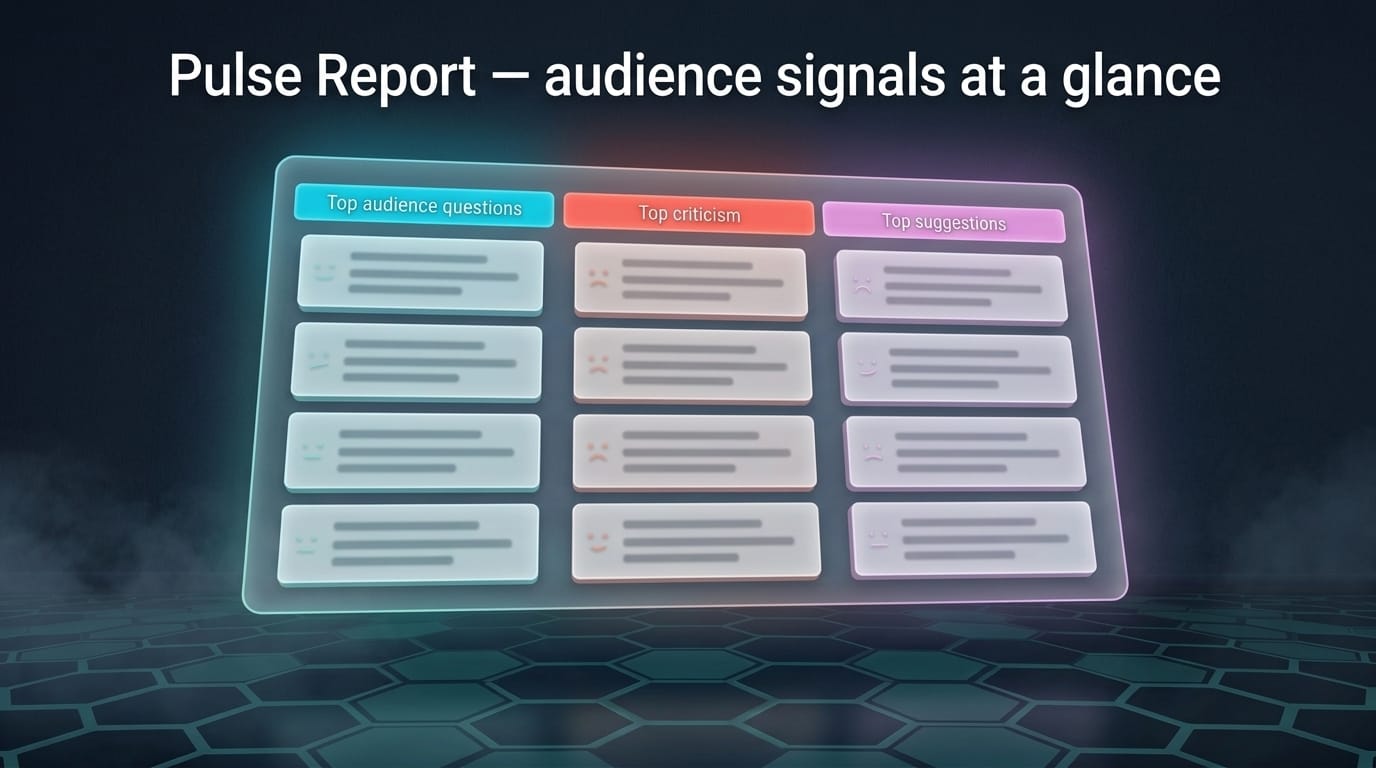
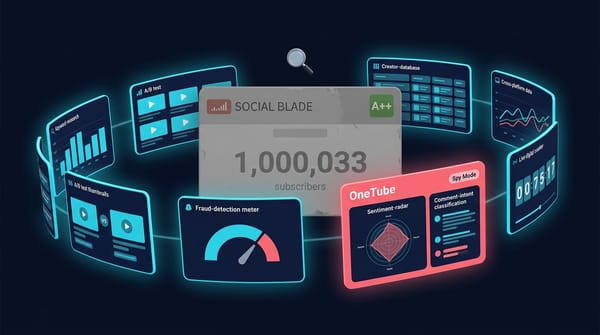
OneTube does this two ways. For your own channel, our comment intelligence pipeline classifies every comment on every video and rolls them into a per-channel Pulse Report with verbatim top audience questions and top content ideas. The second mode is the more interesting one for direction-setting: Spy Mode. Add any public competitor channel to your workspace, and the same pipeline runs against their audience. Their viewers' questions show up in a dedicated competitor_mentions section of the Pulse Report — the things your rivals' audiences are asking for, including the things they haven't gotten yet.
What we see in the data: when a competitor channel gets added in Spy Mode, the Pulse Report's content_gap_topics block almost always surfaces 3-5 themes their audience has been asking about that the channel hasn't covered. Those gaps aren't visible from outside — you can't watch 60 videos and somehow remember every recurring question in the comments. The pipeline can.Turning viewer feedback into content ideas
The mechanic, once you have the data: top recurring questions become next month's video topics. Recurring criticism becomes retention fixes (intro length, audio quality, missing chapters). Recurring praise tells you which formats to double-down on. The hard part of YouTube was never "make videos." It was "pick the right video to make."
MrBeast on ideation discipline: "You need to pick 1 idea out of 100 ideas to make a good video." — in conversation with Marques Brownlee, 2021.
Pulling that into our context: MrBeast can sit with 100 ideas because he has a team and a decade of pattern recognition. Most creators don't. The shortcut isn't generating 100 ideas. It's ranking them — using signals from your actual audience. A "top audience questions" list is already pre-ranked by frequency, by emotion (grateful curiosity ranks higher than skeptical disappointment for content-direction purposes), and by recency. You're not picking 1 out of 100. You're picking from a curated short list that the audience has effectively pre-voted on.
This is also where the AI tooling shift becomes a real lever. 91% of creators now integrate AI into their workflow; 46% specifically use it for creative inspiration (Epidemic Sound Future of the Creator Economy Report 2025). The difference between productive AI use and AI-slop use comes down to what you feed it. Generic "give me 10 video ideas about gaming" is slop. "Here are the 15 recurring questions my niche's audience has asked across 8 channels — generate 10 video ideas that answer the top 5" produces work worth shooting.
TV viewers vs mobile viewers: do they want different content?
Yes, and the gap matters more in 2026 than it did even last year. In February 2025, TV passed mobile as the largest YouTube watch-time surface in the US for the first time (Nielsen via Deadline). By Q4 2025, YouTube on TV accounted for 12.7% of all US TV viewing time (Nielsen via Adwave). Different device, different posture, different content tolerance.
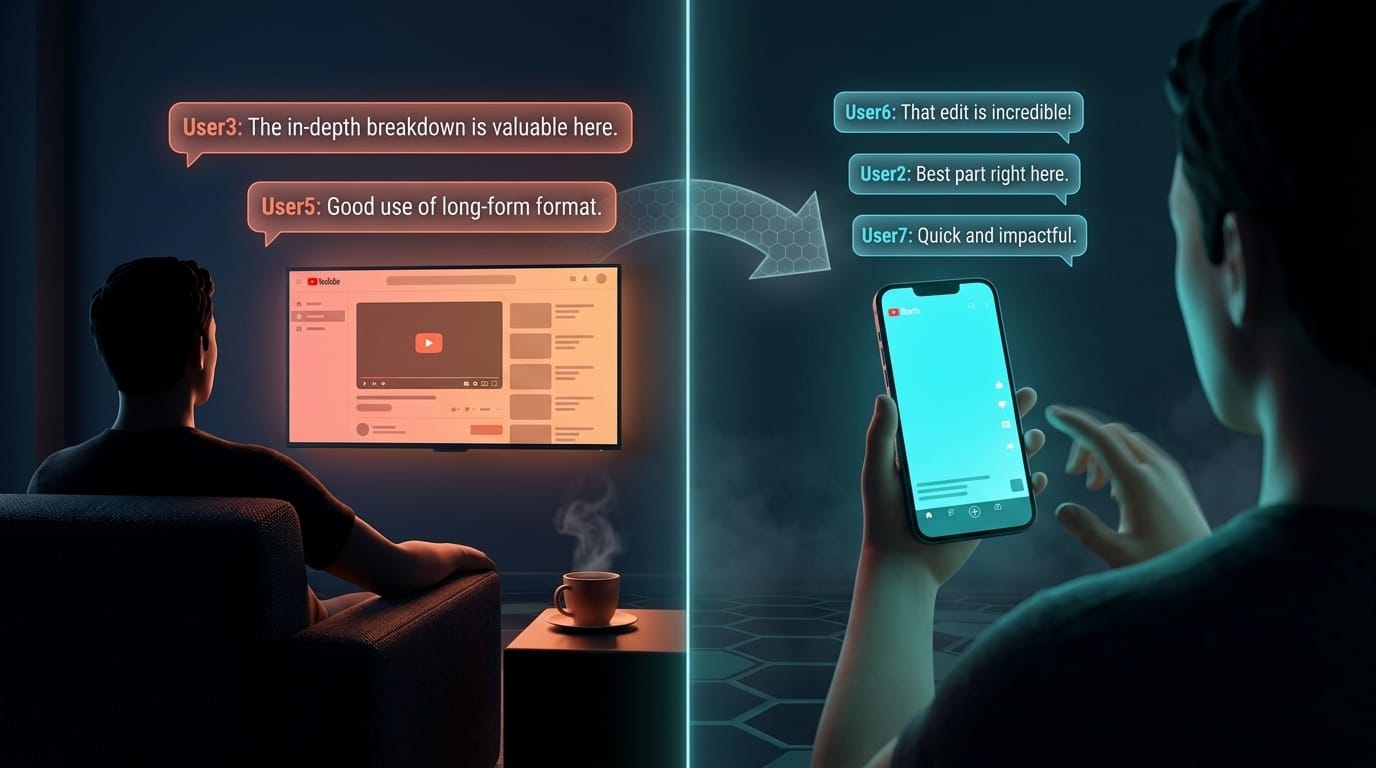
Average TV session on YouTube runs around 45 minutes; mobile averages closer to 20 (Adwave Q3 2025). TV viewers will sit through a 30-minute deep dive. Mobile viewers won't, and Retention Rabbit's 2025 data is brutal here: videos with a clear value proposition in the first 15 seconds saw an 18% lift in retention at the 60-second mark (Retention Rabbit, 2025). On mobile, those first 15 seconds are non-negotiable.
The audience-want implication: the same audience often wants different things on different screens. Your TV viewers might want longer-form explainers from you; your mobile audience may want sharper, faster Shorts versions of the same material. Reading comments by device context — which YouTube Studio surfaces in its analytics — turns one audience into two distinct content briefs.
Tools to understand what your YouTube audience wants
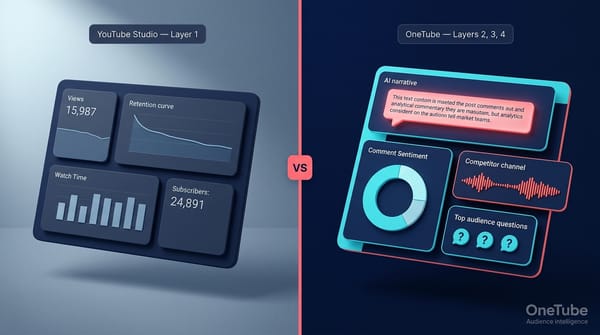
YouTube Studio is the baseline. It's free, it's accurate, and it answers demographic and watch-time questions native to YouTube. What it doesn't do: classify any comment by intent, surface recurring themes, or show you a single data point about a channel you don't own. For that you need third-party tooling — and most of what's marketed as a "YouTube tool" is actually an SEO tool with light analytics bolted on.
| Tool | Comment intent / emotion analysis | Competitor channel data | Recurring-theme surfacing | Free tier |
|---|---|---|---|---|
| YouTube Studio | No | No (own channels only) | No | Free (native) |
| vidIQ | No (comment management only) | Partial (public stats) | No | Free, paid from ~$7.50/mo |
| TubeBuddy | No (moderation tools) | Partial (keyword overlap) | No | Free, paid from $3.50/mo |
| OneTube | Yes — intent and emotion classification per comment | Yes — Spy Mode on any public channel | Yes — Pulse Report top questions / ideas / criticism | 14-day trial, card required |
Track your niche, not just your own channel.
Start your 14-day OneTube trial
OneTube's Spy Mode analyzes comments on any public YouTube channel, your competitors' included. Pulse AI reports, niche trend detection, sentiment and intent analysis. Free for 14 days. Cancel anytime, no charge until day 15.
Start free trial →The pattern that holds across vidIQ and TubeBuddy: both are excellent for pre-upload SEO (titles, tags, keyword research), and both treat comments as something to moderate, not something to analyze. That gap is the entire reason we built OneTube — and why "what do my viewers want" is a question Studio + an SEO tool can't actually answer together. For a fuller side-by-side of the free-tier YouTube analyzer market, we tested 5 of them in Best Free YouTube Channel Analyzers in 2026.
For enterprise teams or MCNs with seat-based budgets, Tubular Labs offers deeper audience demographic intelligence with sales-led pricing — different ICP, included here for completeness.
Frequently asked questions
How can I find out what my YouTube viewers want to see?
Start with two layers: your channel's own comments classified by intent (questions and suggestions are the most direct content signals), and at least 3-5 competitor channels in your niche analyzed the same way. Recurring questions across multiple channels — especially questions still unanswered after months — are the strongest "make this next" signals.
What are the most common things YouTube viewers want?
In our trial-workspace data, viewer comments cluster into a few intent categories: questions, praise, criticism, suggestions, and discussion. Across most channels, questions and suggestions account for 35-50% of substantive comments combined. Praise and criticism tell you what's working and what's breaking. Suggestions tell you what to make next.
How do I analyze YouTube comments to understand my audience?
Manually you can read a few hundred. At scale (4 comments × 30 videos × 5 channels = ~600 per quarter, before competitor analysis) you need tooling that classifies each comment by intent and emotion, then surfaces recurring themes. YouTube Studio doesn't do this; tools like OneTube do it automatically on every channel synced.
What is the best tool for YouTube comment analysis?
For SEO-first creator workflows, vidIQ and TubeBuddy are strong; both treat comments as a moderation surface, not an analysis surface. For audience-intent analysis specifically — including competitor channel comments — OneTube's Comment Analysis + Pulse Reports is purpose-built for that job. YouTube Studio remains the demographic baseline.
How often should I check my YouTube comments for insights?
For most channels, weekly skimming for safety signals (spam, criticism spikes) plus monthly structured analysis is enough. The structured pass is what matters: instead of scrolling, look at a Pulse-style summary of recurring questions, criticism themes, and content suggestions. The weekly skim catches problems; the monthly read catches patterns.
Sources:
- Metricool, YouTube Marketing Statistics 2026, retrieved 2026-05-16, https://metricool.com/youtube-statistics/
- Retention Rabbit, 2025 State of YouTube Audience Retention Benchmark Report, retrieved 2026-05-16, https://www.retentionrabbit.com/blog/2025-youtube-audience-retention-benchmark-report
- Epidemic Sound, Future of the Creator Economy Report 2025, retrieved 2026-05-16, https://corporate.epidemicsound.com/press-and-media/press-releases/2025/content-creators-are-the-new-entrepreneurs-epidemic-sound-unveils-the-future-of-the-creator-economy-report-2025/
- Nielsen via Deadline, YouTube TV exceeds mobile US, February 2025, retrieved 2026-05-16, https://deadline.com/2025/02/youtube-viewership-tv-screens-exceeds-mobile-for-first-time-in-u-s-1236284781/
- Nielsen via Adwave, YouTube TV viewing share Q4 2025, retrieved 2026-05-16, https://adwave.com/resources/youtube-tv-viewing-share-q4-2025/
- Adwave, YouTube TV usage statistics Q3 2025, retrieved 2026-05-16, https://adwave.com/resources/youtube-tv-usage-statistics
- Statista, YouTube comments by video format 2024, retrieved 2026-05-16, https://www.statista.com/statistics/1466529/youtube-comments-by-video-format/
- Gallagher & Hernandez, Algorithmic Anthropomorphizing on r/NewTubers, SAGE 2025, retrieved 2026-05-16, https://journals.sagepub.com/doi/10.1177/20563051251331761
- MrBeast (Jimmy Donaldson) interview with Marques Brownlee, 2021, retrieved 2026-05-16, https://www.youtube.com/watch?v=VAfZugGG4HE
- vidIQ pricing, retrieved 2026-05-16, https://vidiq.com/plans/
- TubeBuddy pricing, retrieved 2026-05-16, https://www.tubebuddy.com/pricing